
 Ready Together
The power of regranting
News and blogsIn this blog, our Director of Operations, Helen Killingley explores the value of regranting.

By Helen Killingley, Director of Operations
This blog is inspired by my conversation earlier this month with Abigail Gibson from Friends Provident Foundation about regranting, and its potential impact to reach and support underserved communities and individuals. Read my key takeaways below.
What is regranting?
Regranting (also known as ‘onward granting’) is a strategic practice where organisations, such as the National Emergencies Trust, work in partnership with other grantmakers to act as a bridge between community groups, or groups supporting specific communities. This ensures that resources flow efficiently to specific communities and causes.
In our case, collaborating with Community Foundations across the UK enables these organisations to regrant the Trust’s appeal funds, broadening the reach and impact of the funds right down to street level.
The value of regranting
Local expertise: we are partnered with UK Community Foundations and their 47-strong network of individual Foundations are based across the whole of the UK. The Community Foundations understand their local communities’ unique needs better than a national grantmaker. Regranting empowers them to distribute funds effectively.
Scaling impact: history has taught us how it has often been the smaller community groups who step up to respond, for example, to support those immediate needs on the ground when an emergency strikes. Extremely large grants can be unwieldy to manage. Regranting to a Community Foundation allows these funds to reach smaller groups without delay. During the Coronavirus Appeal, the Trust acted fast to distribute £2.5m of appeal funds across the UK, and to support local response, within just three days of the first national lockdown being announced.
The regranting life cycle
Regranting involves a cascade effect, akin to the many tiers of a waterfall:
- Large grantmakers: such as central Government, corporates or major foundations providing substantial grants.
- Intermediaries: Organisations like the National Emergencies Trust partner with local community foundations to distribute funds locally to where they are needed.
- Local-level grants: These intermediary organisations, such as Local Community Foundations, then regrant funds to local community groups or specific community-led projects.
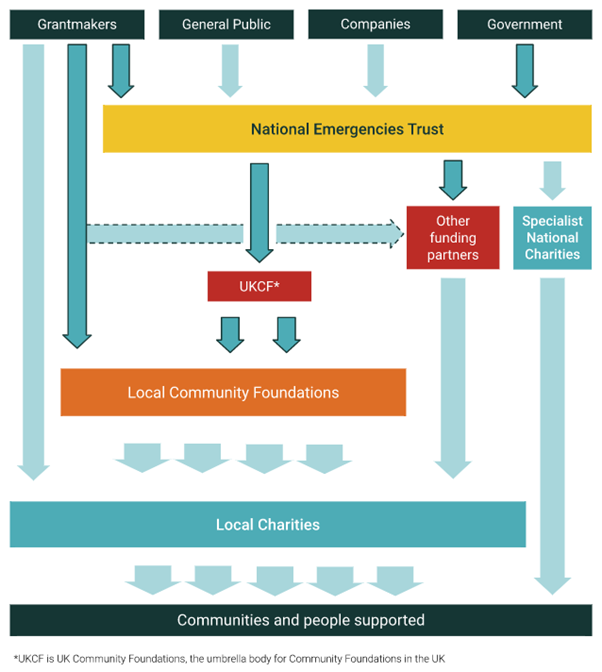
Image credit: 360Giving
Aligning with IVAR’s principles and publishing data to 360Giving
Our commitment to IVAR’s Open and Trusting funding principles resonates with the need for transparent, community-driven regranting. We publish our funding data openly and use the 360Giving Data Standard to ensure accountability so that we can learn and make continuous improvements following emergency appeals.
The power of regranting: reach and impact
During the pandemic, both Community Foundations and the Trust’s other funding partners such as LGBT+ Consortium or the consortium of Disabled People’s Organisations (led by Disability Action Northern Ireland), acted as a bridge to reach and support those underserved communities and individuals without delay. Nottingham Trent University’s independent evaluation (opens in a new tab) of the Trust’s first Appeal emphasised the importance of devolving decision-making power to local actors along with the importance of trust, flexibility and evolving criteria.
Mitigating risk
When an emergency occurs, the risk of fraud spikes. Regranting, when managed well, safeguards against misuse. During the Coronavirus Appeal an independent assessment reported that the fraud level for funds regranted to the Community Foundation network were below the 0.5% to 5% range that the Cabinet Office’s Fraud Measurement and Assurance Oversight Board estimates for public expenditure.
Lessons learnt
- Collaboration: Partnerships between grant-makers, intermediaries, and local movements enhance impact.
- Adaptability: Regranting programmes must evolve alongside community needs.
- Data-sharing: Seamless integration with 360Giving facilitates learning and more informed decision-making.
In summary, regranting isn't just about moving funds—it's about empowering communities, fostering trust, and amplifying impact. Every regrant is a ripple that can create waves of positive change. During emergencies this ripple can help ensure that help is directed to where it is needed the most, thanks to partnering with both local and national organisations with specialist knowledge.
You can read more about regranting in the blog post Following the Money: Exploring Regrants in the 360Giving Data Standard (opens in a new tab) on the 360Giving website.